
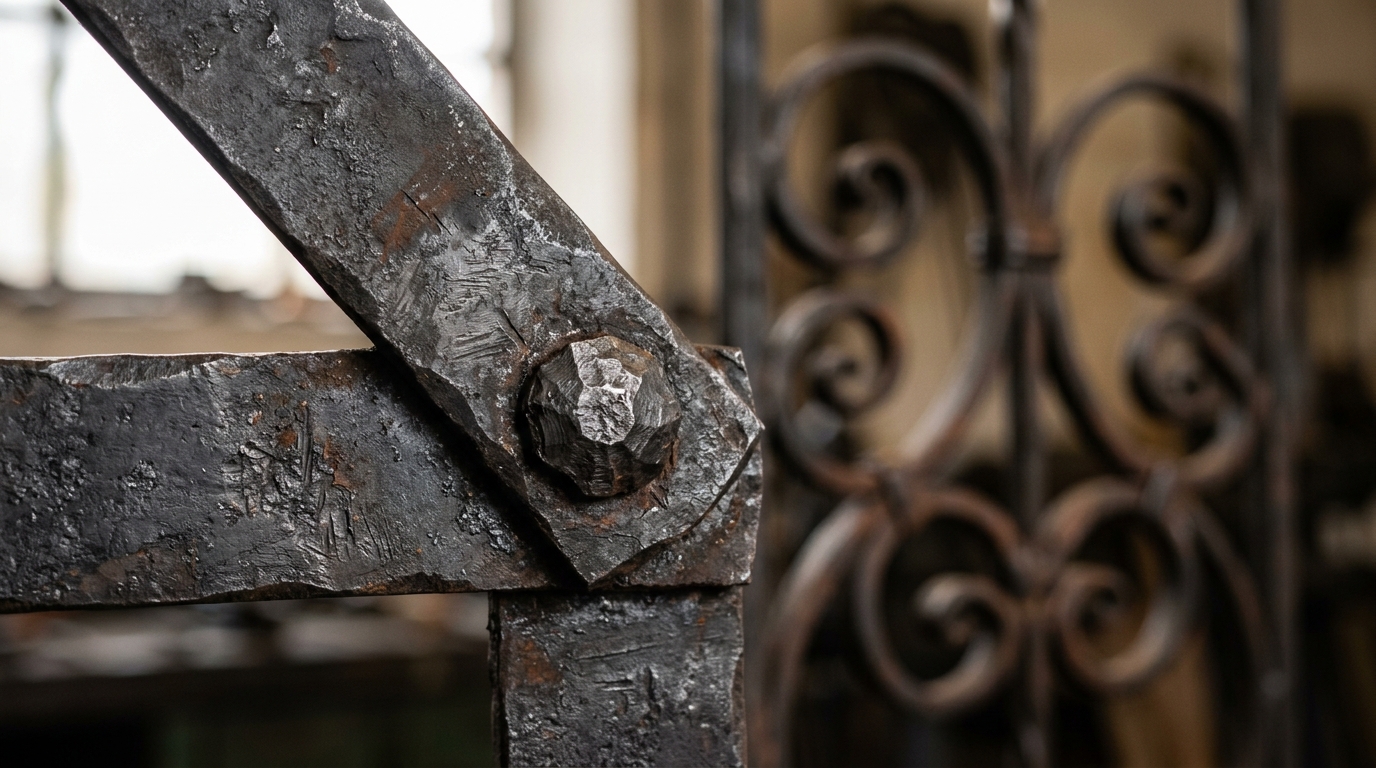
1. Hot Riveting: The Foundation of Structural Strength
Hot rivets are cylindrical wrought iron or mild steel fasteners placed through matching holes in adjacent bars while glowing bright cherry red (roughly 1,500°F / 815°C). The smith uses a rivet snap and ball-peen hammer to upset the protruding shank, forming a smooth domed head.
As the hot rivet cools, thermal contraction causes the metal to shrink lengthwise. This shrinkage exerts thousands of pounds of longitudinal clamping force, drawing the two pieces of iron together with a mechanical tightness that eliminates all play and vibration.
2. Hot Collars: Elegant Wraps Without Visible Fasteners
Collars are decorative and structural iron bands wrapped around overlapping scrollwork and pickets. The smith heats a flat strap of iron, folds it around the bundle over a swage block or bottom hardy tool, and hammers it tight against the scrollwork.
As with rivets, when the collar cools from red heat to room temperature, it contracts forcefully around the iron bars, locking the decorative scroll assemblies into a rigid, monolithic framework that will endure for centuries without loosening.
3. Tenon & Pass-Through Joinery
For grilles and window gates, vertical pickets pass directly through the center of horizontal structural rails. The smith punches rectangular slots in the rail at yellow heat using a slit chisel and tapered drift, then shapes matching round or square tenons on the pickets. Peening the tenon ends over the top rail locks the entire geometric assembly into place with timeless visual rhythm.
4. Splitting, Drifting, and Scroll Terminal Anatomy
To craft historic grilles and gates that feature intricate organic curves, the blacksmith begins by forming delicate terminals at the tips of raw iron bars. Traditional terminal motifs include the fish-tail, the snub-end scroll, and the leaf-forged flare. Each terminal is tapered over the horn of the anvil before being wound around a scrolling fork.
Unlike modern welded steel fabrications with sharp, flat, and lifeless joint lines, traditional architectural ironwork exhibits subtle organic thickness variations known as swelling and thinning. Every mechanical joint acts as a natural focal point, celebrating the thermal physics and human labor required to forge raw elemental iron into enduring architectural art.
5. Traditional Anti-Corrosion Finishes
Preserving exterior architectural iron without hiding the subtle hand-hammered texture under thick modern plastic coatings requires traditional metallurgical surface treatments. Authentic finishes include hot beeswax-boiled linseed oil quenching (applied at black heat, roughly 400°F) or historic coal-tar japanning. These traditional permeable finishes penetrate deep into the microscopic surface pores of the iron, forming a resilient, water-repellent patina that ages gracefully with rich, dark luster across decades of outdoor weather exposure.
Mastering the Anvil Rebound and Hammer Rhythm
The true secret to forging steel efficiently with minimal physical exhaustion lies in mastering the elastic rebound of a quality wrought iron or cast steel anvil. Striking with a relaxed wrist and allowing the natural 80% to 90% rebound velocity of the anvil face to return the hammer to the apex of the swing cycle reduces arm fatigue by more than half.
Every hammer blow should serve a distinct purpose—drawing, beveling, or planishing—with the blacksmith continuously rotating the workpiece between 90-degree orthogonal planes to maintain square geometry before radiusing edges into round or octagonal profiles.
Shop Safety, Eye Protection, and Fire Management
Operating a hot forge requires rigorous personal safety discipline. Always wear clear ballistic eye protection with side shields to guard against airborne slag and flying scale. Never wear synthetic fleece or polyester clothing that can melt onto skin upon contact with red-hot sparks; choose natural heavy cotton denim or leather shop aprons. Maintain an unobstructed 5-gallon water quench tub within arm's reach of the anvil horn for emergency tool cooling and fire suppression.