
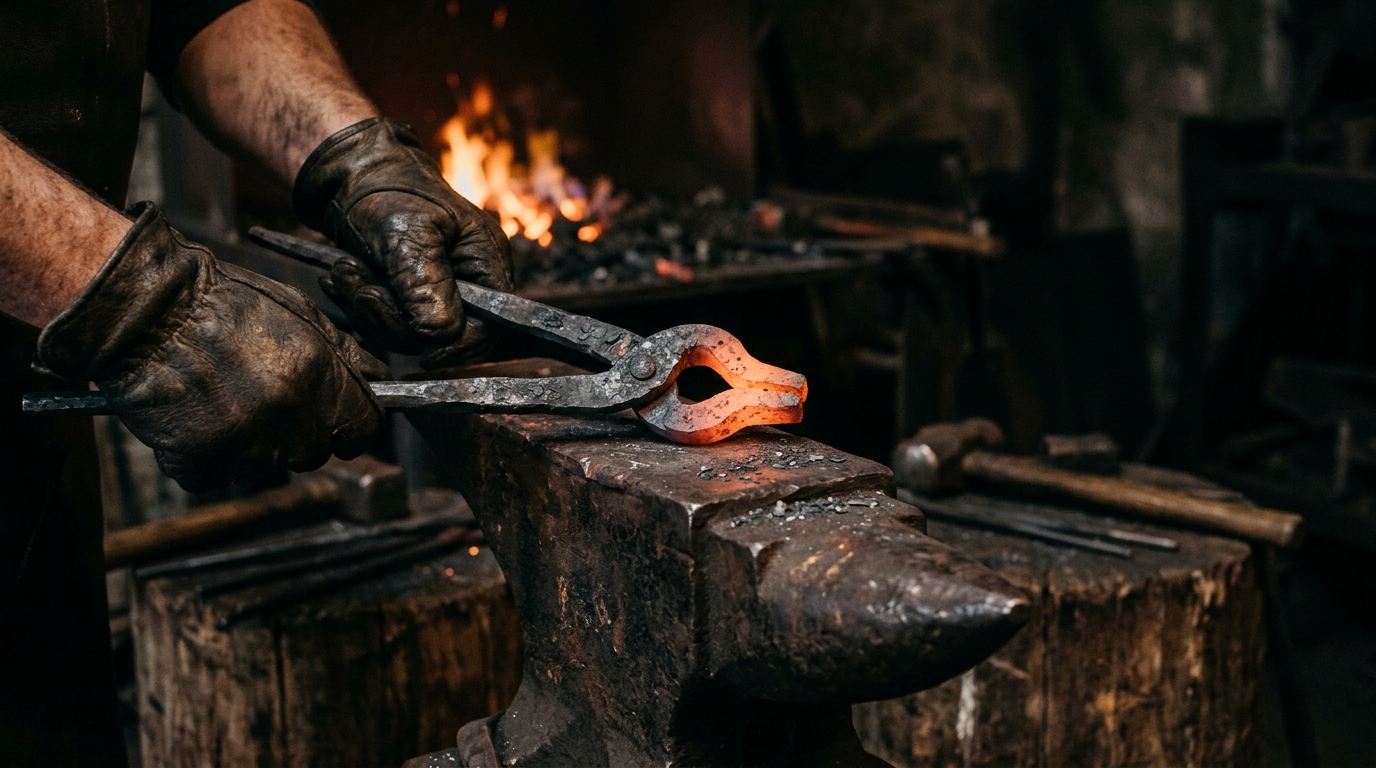
1. Selecting Steel Stock: Why Mild Steel Over Tool Steel
Beginner smiths often make the mistake of using high-carbon spring steel for tong reins. When tongs are continually quenched in the slack tub to cool the jaws, high-carbon steel hardens and becomes brittle, eventually snapping under grip pressure.
Mild steel (AISI 1018 or A36) is the premier choice for blacksmith tongs because it cannot be hardened by water quenching. Even when repeatedly submerged in water, mild steel remains ductile, tough, and safe from catastrophic fracturing.
2. The 3-Step Jaw, Boss, and Rein Transition
Every tong half (bit) requires executing three precise 90-degree rotational half-face hammer blows over the far edge of the anvil:
- Forging the Bit (Jaw): Half-face hammer blow on the near side of the anvil at bright orange heat, drawing out the gripping profile.
- Rotating 90° Clockwise for the Boss: Stepping to the far edge of the anvil and striking with the hammer half-on, half-off the anvil to isolate the pivot boss.
- Rotating 90° Clockwise for the Rein: Offsetting the bar to begin drawing out the long, tapered handle reins.
3. Punching, Riveting, and Jaws Tuning
Drilling the pivot hole weakens the grain structure. Instead, hot punch a 3/8-inch hole through both bosses, insert a mild steel rivet at yellow heat, and peen the head. Finally, heat the assembled jaws to orange heat, clamp a square steel bar tightly between the bits, and quench while gripping to achieve perfect parallel clamping alignment.
4. Troubleshooting Common Forging Mistakes on the Boss
The pivot boss is the mechanical weak point of poorly constructed tongs. If the smith fails to maintain proper stock thickness while isolating the boss step, the rivet will stretch the thin metal during heavy gripping, causing the jaws to wobble sideways. To prevent this, always leave the boss section at least 3/8-inch (10mm) thick before punching.
Furthermore, ensure the reins taper smoothly without abrupt sharp inside shoulders. Sharp transition corners act as stress-risers where metal fatigue can induce hairline cracking under repeated high-leverage clamping cycles.
5. Crafting Dedicated V-Bit Jaws for Square and Round Bar
While flat-jaw tongs are adequate for thin plate, holding heavy round or square stock securely requires forming dedicated V-Bit grooves along the inner faces of both jaws. At bright orange heat, place the heated jaw over the 90-degree corner of the anvil and strike with a cross-peen hammer to forge a clean longitudinal V-channel. Once assembled, V-bit tongs provide unmatched multi-axis clamping stability, preventing hot steel billets from twisting or ejecting unexpectedly under heavy power hammer or sledgehammer blows.
Mastering the Anvil Rebound and Hammer Rhythm
The true secret to forging steel efficiently with minimal physical exhaustion lies in mastering the elastic rebound of a quality wrought iron or cast steel anvil. Striking with a relaxed wrist and allowing the natural 80% to 90% rebound velocity of the anvil face to return the hammer to the apex of the swing cycle reduces arm fatigue by more than half.
Every hammer blow should serve a distinct purpose—drawing, beveling, or planishing—with the blacksmith continuously rotating the workpiece between 90-degree orthogonal planes to maintain square geometry before radiusing edges into round or octagonal profiles.
Shop Safety, Eye Protection, and Fire Management
Operating a hot forge requires rigorous personal safety discipline. Always wear clear ballistic eye protection with side shields to guard against airborne slag and flying scale. Never wear synthetic fleece or polyester clothing that can melt onto skin upon contact with red-hot sparks; choose natural heavy cotton denim or leather shop aprons. Maintain an unobstructed 5-gallon water quench tub within arm's reach of the anvil horn for emergency tool cooling and fire suppression.