
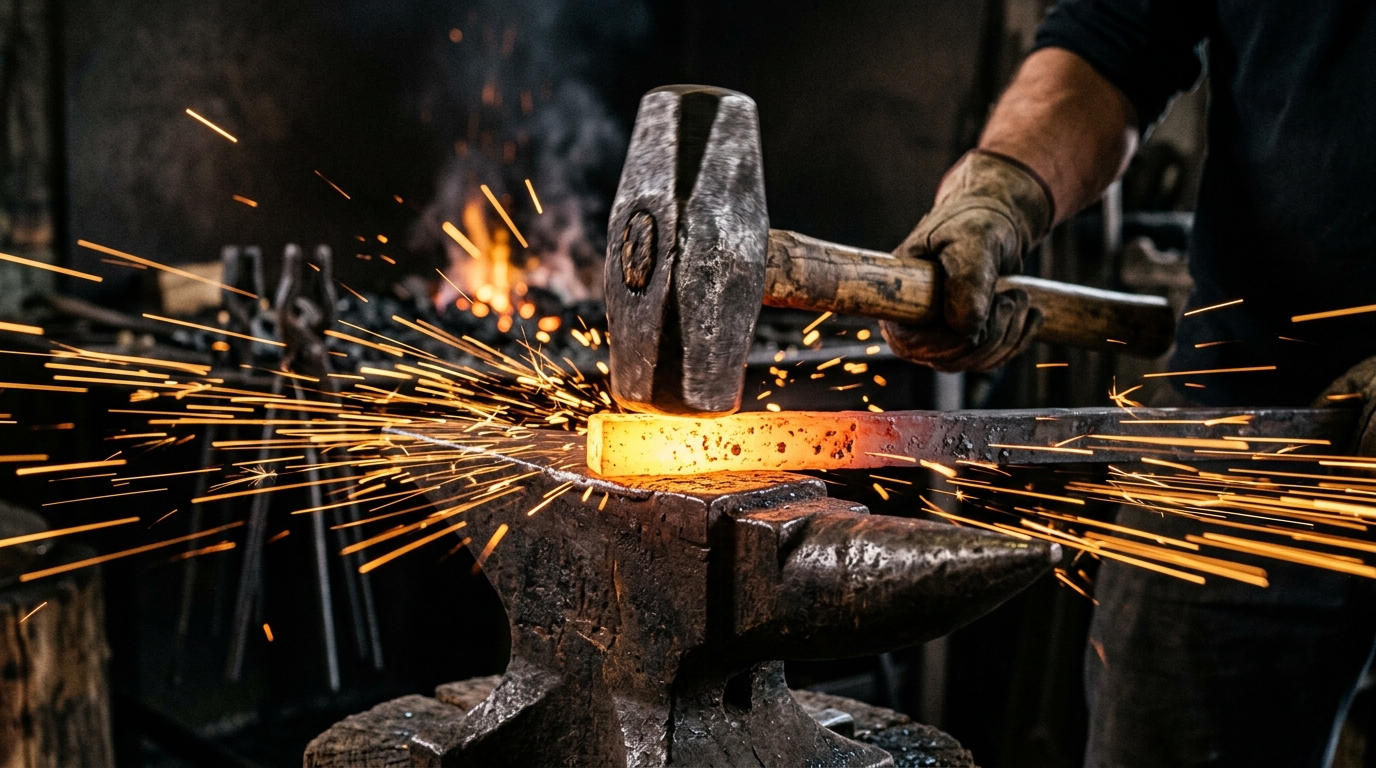
At its core, blacksmithing is the art of moving metal in three-dimensional space without cutting away chips. Every complex gate, surgical knife, or ornate chandelier is simply a combination of three primary physical manipulations: drawing out (lengthening), upsetting (thickening), and bending.
1. Biomechanics: The French Grip vs. Piston Strike
Beginners often grip the hammer with a white-knuckled "baseball grip" and swing strictly from the elbow, resulting in acute tendonitis (blacksmith's elbow) within weeks.
Master smiths use the relaxed French Grip: the thumb rests lightly along the side or top of the hickory handle, and the last two fingers relax on the upswing. On impact, the fingers tighten, allowing the anvil's rebound energy to throw the hammer back upward effortlessly. The power originates from the shoulder and torso, not the isolated wrist.
2. Drawing Out (Lengthening and Tapering)
Drawing out transforms thick, short bar stock into a longer, thinner bar. If you hammer directly on the flat anvil face with a flat hammer, metal expands in all directions equally (both length and width).
To accelerate drawing efficiency, forge over the horn of the anvil or use the cross-peen of your hammer. The curved radius of the horn acts as a concentrated wedge, displacing steel lengthwise while minimizing unwanted lateral spreading. Always keep stock square while drawing down; turning round stock into a taper without forging square first causes internal centerline shear cracks (alligatoring).
🔨 Core Stock Manipulations Defined
Drawing Out
Decreases cross-section area to increase overall length.
Upsetting
Shortens stock to increase thickness locally at the bar end.
Bending & Scrolling
Curving stock over anvil horn or between bending forks.
3. Upsetting: Adding Mass to Hot Steel
Upsetting is the inverse of drawing out. It is used to create flared bolt heads, tenon shoulders, or decorative knuckles.
To upset successfully, you must achieve a localized bright yellow heat on the end of the bar while keeping the remainder of the bar cold (achieved by dipping the shank in the slack tub). Place the hot tip on the anvil face and deliver heavy, deliberate blows straight down the central axis of the bar. If the bar begins to bend like a banana, immediately lay it flat and straighten it before continuing.
4. Bending and Scrolling: Pure Fluid Line Work
Bending relies on the anvil horn or step. To forge a graceful scroll without hammer marks, project the tapered end of the bar slightly over the far edge of the anvil and strike with glancing blows downwards. Roll the curled tip toward yourself, continuously presenting new hot surface to the horn.
By practicing these three mechanical actions daily, you develop the muscle memory to shape hot steel with fluid, effortless precision.
4. Body Mechanics, Hammer Grip, and Anvil Ergonomics
Blacksmithing is an art of leverage and rhythm rather than brute force. A smith who relies purely on bicep and shoulder strength will suffer tendonitis within months. The master blacksmith uses the body's natural kinetic chain—initiating energy from the hips and torso, allowing gravity to drop the heavy hammer face, and using the high elastic rebound of a quality cast steel anvil (80%+ rebound efficiency) to lift the hammer back to the top of the swing cycle.
Anvil height must be calibrated precisely: when standing upright with arms relaxed at your sides, the top face of the anvil should sit exactly level with your knuckles. Maintain a relaxed grip with the thumb wrapped around the hammer handle rather than resting on top of the spine, allowing the wrist to pivot freely without transmitting shock directly into the elbow joint.
Mastering the Anvil Rebound and Hammer Rhythm
The true secret to forging steel efficiently with minimal physical exhaustion lies in mastering the elastic rebound of a quality wrought iron or cast steel anvil. Striking with a relaxed wrist and allowing the natural 80% to 90% rebound velocity of the anvil face to return the hammer to the apex of the swing cycle reduces arm fatigue by more than half.
Every hammer blow should serve a distinct purpose—drawing, beveling, or planishing—with the blacksmith continuously rotating the workpiece between 90-degree orthogonal planes to maintain square geometry before radiusing edges into round or octagonal profiles.
Shop Safety, Eye Protection, and Fire Management
Operating a hot forge requires rigorous personal safety discipline. Always wear clear ballistic eye protection with side shields to guard against airborne slag and flying scale. Never wear synthetic fleece or polyester clothing that can melt onto skin upon contact with red-hot sparks; choose natural heavy cotton denim or leather shop aprons. Maintain an unobstructed 5-gallon water quench tub within arm's reach of the anvil horn for emergency tool cooling and fire suppression.