
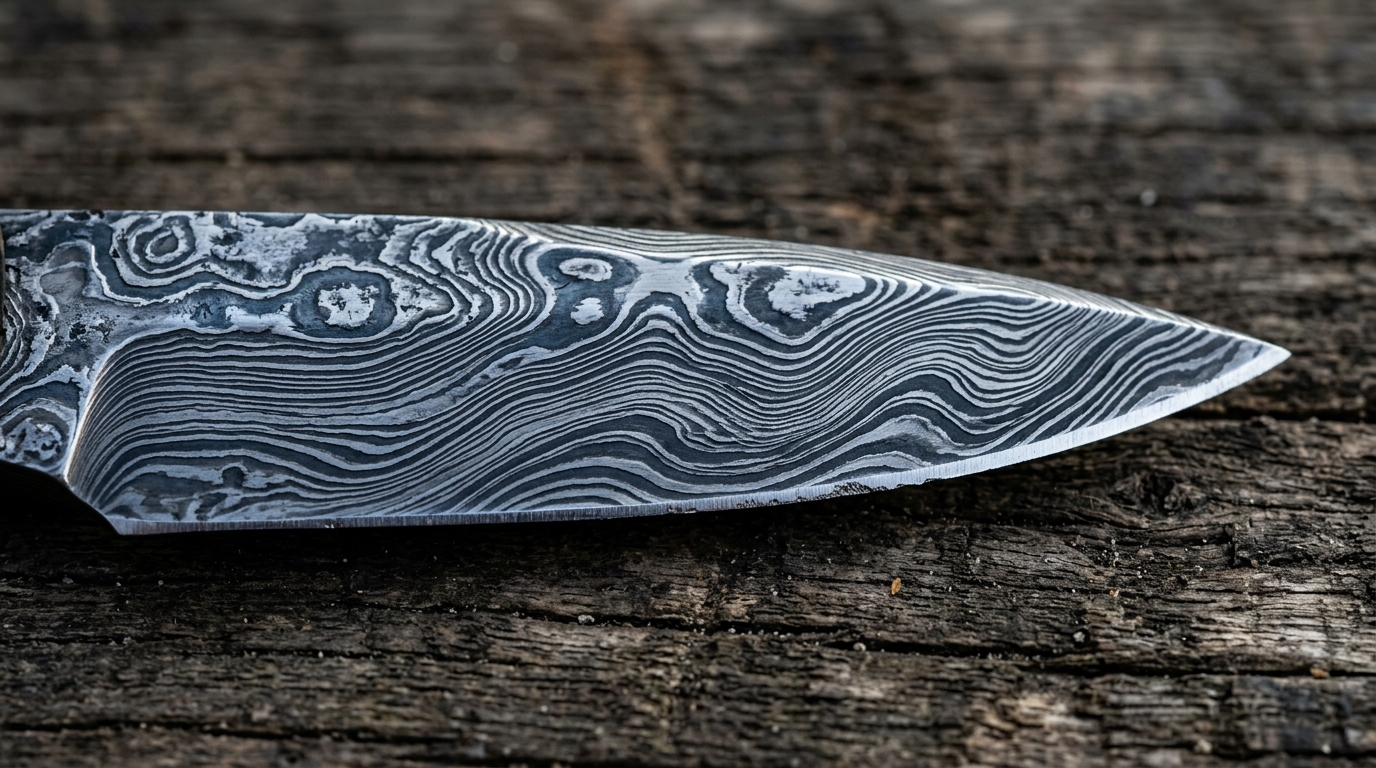
Few materials in the history of martial warfare and craftsmanship have captured the human imagination like Damascus steel. Renowned throughout the Crusades for slicing silk handkerchiefs in mid-air and shattering Western European iron longswords without notching, the original metallurgical formula seemed to vanish abruptly in the early 19th century.
1. Historical Wootz: The True Crucible Steel of the East
The genuine historical Damascus blade was not forged from laminated sheets of steel, but manufactured from a single high-carbon crucible ingot known in Southern India and Sri Lanka as Wootz (or Ukku).
Beginning as early as 300 BCE, ancient smelters loaded small clay crucibles with porous sponge iron, charcoal chips, green leaves of Cassia auriculata, and glass slag. Sealed airtight with clay and fired inside natural draft blast furnaces for days, the iron absorbed massive amounts of carbon (1.5% to 2.0% C), melting into a crystalline hemispherical button ingot.
2. The Mystery of the Missing Vanadium & Carbide Banding
For centuries, metallurgists who tried to forge Wootz ingots failed because high-carbon hyper-eutectoid steel crumbles into brittle chunks when struck at standard red heat. The secret lay in delicate, ultra-low-temperature forging (between 1,200°F and 1,550°F, dull blood red).
Pioneering research by metallurgists John Verhoeven and master bladesmith Alfred Pendray proved that the famous swirling water pattern (jauhar) was generated by minute traces of vanadium (as low as 0.003%) present in specific regional Indian iron ore deposits. During repeated thermal cycles, vanadium nucleated aligned sheets of microscopic cementite (iron carbide) particles within a softer, flexible pearlite matrix, giving the blade razor-sharp teeth on a flexible spine. When the specific mine veins were exhausted in the 1800s, the trade route collapsed, and the art was temporarily lost to history.
🪓 Historical Wootz vs. Modern Pattern-Welded Damascus
Crucible Wootz (Ancient)
Single cast ingot with natural cementite carbide bands. Vanadium-catalyzed micro-crystallization.
Pattern Welded (Modern)
Solid-state forge-welded billet layering high-carbon steel (1095) with nickel steel (15N20) revealed via ferric chloride acid etching.
3. The Alchemy of Modern Pattern Welding
Today, custom bladesmiths achieve breathtaking visual patterns by forge-welding alternating layers of dissimilar steels into a unified solid billet. The two most common workhorse steels are AISI 1095 (dark, high-carbon steel that provides supreme edge hardness) and 15N20 (contains 2.0% nickel, which resists acid etching and gleams bright silver).
A typical billet starts with 15 alternating layers. Heated to a dazzling welding temperature of 2,300°F (bright yellow-white) with anhydrous borax flux to prevent scale oxidation, the smith hammers the stack into a monolithic block. It is drawn out, cut into sections, restacked, and re-welded. Repeating this process five times creates a billet containing over 400 distinct micro-layers.
4. Manipulating Visual Patterns: Ladder, Raindrop, and Mosaic
Straight layers of steel produce simple horizontal lines. To create mesmerizing visual art, smiths manipulate the internal topography before final grinding:
- Ladder Pattern: Shallow grooves are ground perpendicular to the billet length or pressed with fullering dies, and the billet is then hammered flat to expose distorted cross-sections.
- Raindrop Pattern: Dimples are drilled with a ball-end mill across the surface and forged flush, creating concentric circular rings resembling falling rain.
- Twist (Damascus Cable): The entire billet is brought to welding heat and rotated axially under mechanical torsion, creating spiral serpentine bands along the cutting edge.
5. The Acid Etch: Revealing the Hidden Fire
When a pattern-welded knife is polished to a 2,000-grit satin finish, the steel looks deceptively uniform. The magic occurs during chemical development. Submerging the blade in a bath of diluted ferric chloride (FeCl3) eats away at the 1095 carbon steel while leaving the nickel-rich 15N20 layers untouched in high relief.
Whether evaluating an archaeological Wootz shamshir in an imperial museum or hand-forging a modern custom hunting knife, Damascus steel remains the ultimate testament to metallurgical artistry and the indomitable craft of the bladesmith.
Mastering the Anvil Rebound and Hammer Rhythm
The true secret to forging steel efficiently with minimal physical exhaustion lies in mastering the elastic rebound of a quality wrought iron or cast steel anvil. Striking with a relaxed wrist and allowing the natural 80% to 90% rebound velocity of the anvil face to return the hammer to the apex of the swing cycle reduces arm fatigue by more than half.
Every hammer blow should serve a distinct purpose—drawing, beveling, or planishing—with the blacksmith continuously rotating the workpiece between 90-degree orthogonal planes to maintain square geometry before radiusing edges into round or octagonal profiles.
Shop Safety, Eye Protection, and Fire Management
Operating a hot forge requires rigorous personal safety discipline. Always wear clear ballistic eye protection with side shields to guard against airborne slag and flying scale. Never wear synthetic fleece or polyester clothing that can melt onto skin upon contact with red-hot sparks; choose natural heavy cotton denim or leather shop aprons. Maintain an unobstructed 5-gallon water quench tub within arm's reach of the anvil horn for emergency tool cooling and fire suppression.