
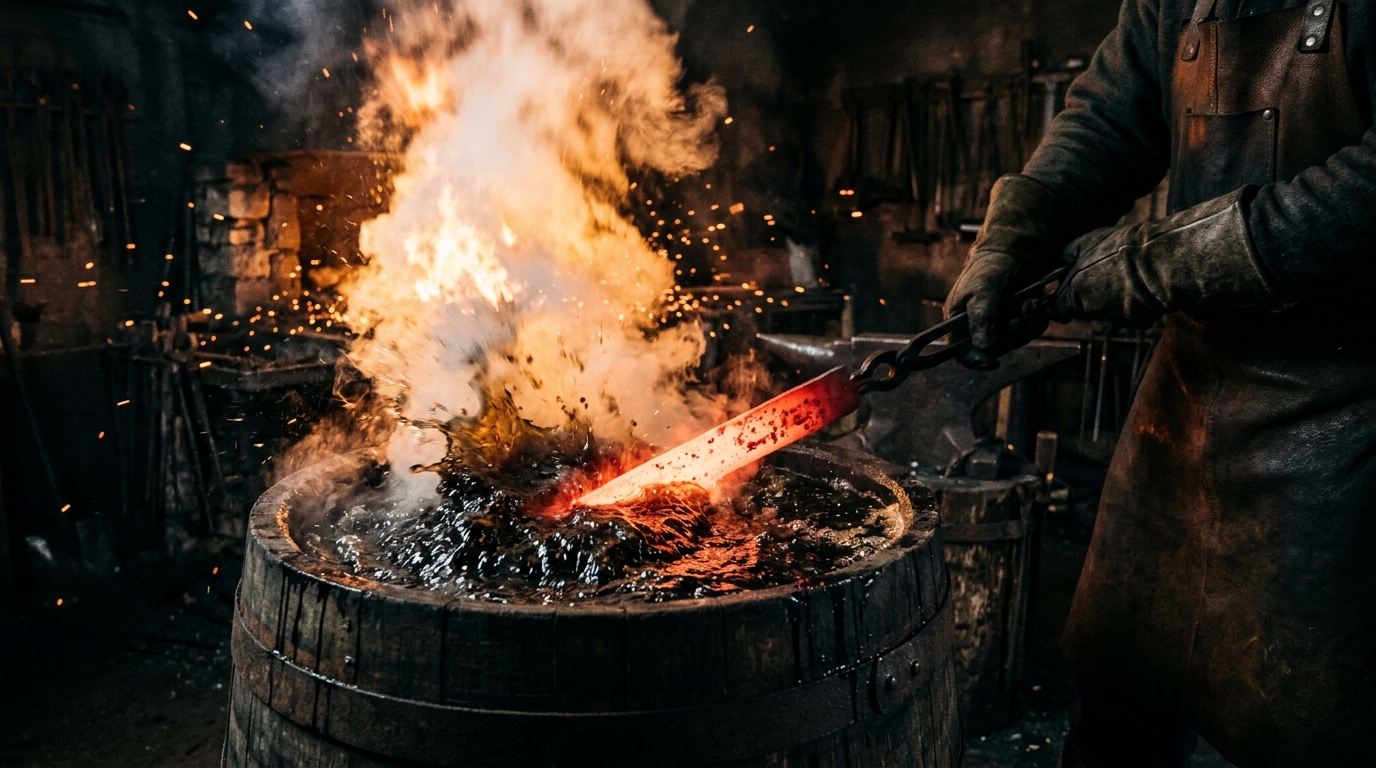
You can forge the most geometrically flawless knife in the world, but without proper heat treatment, it is merely a decorative piece of soft iron. Heat treatment is the true crucible where physics, chemistry, and thermodynamics dictate whether steel will hold an enduring surgical edge or snap upon first impact.
1. The Microscopic Dance: From Ferrite to Austenite
At room temperature, carbon steel exists in a crystalline state known as Ferrite (body-centered cubic iron) mixed with Cementite (Fe3C iron carbides). In this condition, the steel is soft and easily machined.
When heated past its critical transformation temperature (~1,475°F to 1,550°F depending on carbon percentage), the iron atoms rearrange into a face-centered cubic structure called Austenite. In austenite, carbon atoms dissolve completely into the iron crystal matrix like sugar dissolving into hot coffee.
2. The Quench: Beating the Pearlite Nose
If steel cools slowly in ambient air, the carbon has time to diffuse out of solution, reforming soft pearlite. To harden steel, you must plunge the blade into a liquid medium rapidly enough to "beat the nose" of the Time-Temperature-Transformation (TTT) curve.
Cooling the steel from 1,500°F to below 900°F in under one second traps the dissolved carbon atoms inside the lattice. Unable to escape, the crystal shears into a distorted, highly stressed tetragonal structure called Martensite. As-quenched martensite is glass-hard (65–67 HRC) and so brittle that dropping it on a concrete floor will shatter the blade into fragments.
🧪 The Three Essential Stages of Blade Heat Treatment
1. Normalizing
3 thermal cycles to refine grain size and eliminate forged internal stress.
2. Quenching
Rapid cooling in engineered oil to freeze carbon into needle-like Martensite.
3. Tempering
Controlled 400°F reheat to trade 3-5 HRC hardness points for immense toughness.
3. Choosing the Correct Quench Medium
Never quench simple tool steels in motor oil (which releases toxic volatile carcinogens) or cold water (which causes severe steam pockets and catastrophic warp cracks).
Use modern engineered quenching oils (such as Parks 50 for shallow-hardening steels like 1095 and W2, or Parks AAA / Houghton K for deep-hardening alloy steels like 5160 and 80CrV2). Pre-warming the oil to 120°F–130°F lowers viscosity, accelerating the vapor jacket collapse stage and ensuring uniform, warp-free heat extraction.
4. Tempering: Transforming Brittleness into Toughness
Immediately after the blade reaches room temperature following the quench, it must undergo tempering. Placing the blade in a calibrated oven at 375°F to 425°F for two consecutive 2-hour cycles allows microscopic amounts of carbon to precipitate out, transforming untempered martensite into Tempered Martensite.
This drops hardness slightly to an optimal 59–61 HRC—retaining razor-sharp edge longevity while providing the elastic flexural strength required to withstand severe cutting tasks without chipping.
4. Quench Agitation and Avoiding the Vapor Phase
When red-hot steel plunges into liquid quenching oil, the heat instantly vaporizes the liquid, creating an insulating vapor blanket (the Leidenfrost effect) around the blade. If this vapor blanket lingers, cooling rates slow down, allowing pearlite to form and causing soft spots in the hardened edge.
To break the vapor envelope, the smith must agitate the blade with smooth, rhythmic slicing motions (forward and backward, cutting through the oil like a sword) rather than moving side-to-side. Side-to-side agitation creates uneven cooling between the left and right bevels, causing the blade to warp severely into an irreversible curve.
Mastering the Anvil Rebound and Hammer Rhythm
The true secret to forging steel efficiently with minimal physical exhaustion lies in mastering the elastic rebound of a quality wrought iron or cast steel anvil. Striking with a relaxed wrist and allowing the natural 80% to 90% rebound velocity of the anvil face to return the hammer to the apex of the swing cycle reduces arm fatigue by more than half.
Every hammer blow should serve a distinct purpose—drawing, beveling, or planishing—with the blacksmith continuously rotating the workpiece between 90-degree orthogonal planes to maintain square geometry before radiusing edges into round or octagonal profiles.
Shop Safety, Eye Protection, and Fire Management
Operating a hot forge requires rigorous personal safety discipline. Always wear clear ballistic eye protection with side shields to guard against airborne slag and flying scale. Never wear synthetic fleece or polyester clothing that can melt onto skin upon contact with red-hot sparks; choose natural heavy cotton denim or leather shop aprons. Maintain an unobstructed 5-gallon water quench tub within arm's reach of the anvil horn for emergency tool cooling and fire suppression.