
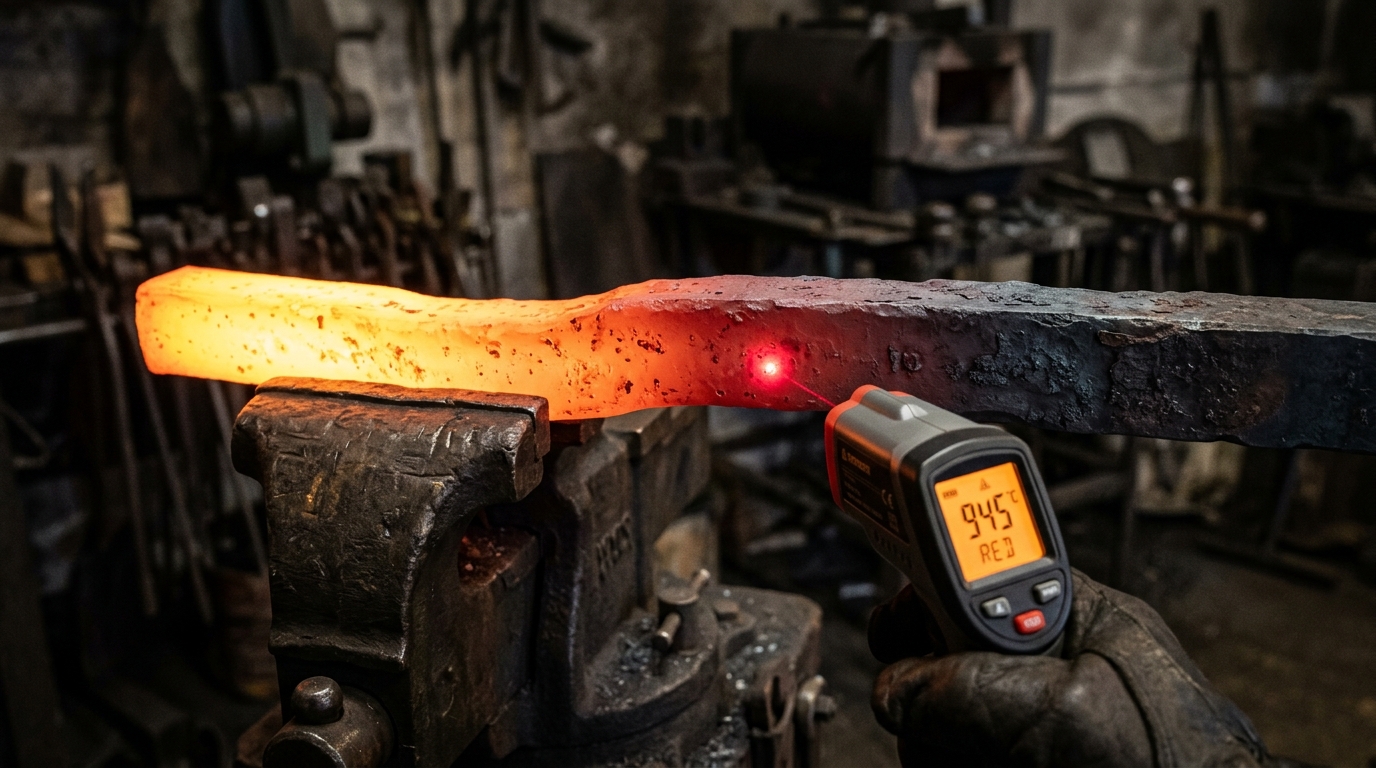
Before digital digital thermocouples and infrared laser pyrometers existed, blacksmiths relied solely on visual perception to judge metal temperature. As steel absorbs thermal energy, its atomic lattice vibrates, radiating electromagnetic energy across the visible light spectrum. Learning to "read the color of the steel" is the defining rite of passage for every hand forger.
1. The Blacksmith's Ambient Light Rule
The first rule of visual pyrometry is controlling your shop lighting. Direct sunlight or bright fluorescent bulbs will wash out the steel's glow, causing you to drastically overheat the workpiece (often burning carbon out of tool steels).
Always forge in semi-diffused, indirect shade. In historical European smithies, windows were deliberately small and faced north to guarantee consistent, uniform ambient shadow throughout the seasons.
| Visual Color | Fahrenheit | Celsius | Appropriate Operation |
|---|---|---|---|
| Faint Blood Red | 900°F - 1,050°F | 480°C - 565°C | Black heat. Dangerous to strike high-carbon steel (causes stress fractures). |
| Dark Cherry Red | 1,175°F - 1,300°F | 635°C - 700°C | Stress relief annealing, sub-critical grain normalization. |
| Bright Cherry Red | 1,400°F - 1,550°F | 760°C - 845°C | Austenitizing phase. Ideal quenching window for 1084/1095 carbon steels. |
| Full Salmon Orange | 1,700°F - 1,950°F | 925°C - 1,065°C | Standard forging heat. Maximum plasticity for heavy drawing and upsetting. |
| Lemon Yellow | 2,000°F - 2,200°F | 1,090°C - 1,200°C | Heavy stock reduction on power hammers. High scaling rate. |
| Brilliant White / Welding Heat | 2,300°F - 2,450°F | 1,260°C - 1,340°C | Forge welding Damascus billets. Steel looks wet/greasy. Sparks indicate combustion. |
2. The Curie Point: Magnetism as an Objective Benchmark
When heat-treating blades without electronic controllers, you can calibrate your eyes using a simple rare-earth magnet hung on a brass chain by your anvil.
At precisely 1,414°F (768°C), carbon steel transitions from body-centered cubic (ferrite) to face-centered cubic (austenite) and loses its ferromagnetism completely. This is the Curie Point. Touch the steel to the magnet: when it stops sticking, you are within 50 degrees of ideal austenitizing temperature for simple tool steels.
3. Recognizing "Burning Steel": When Fire Turns Destructive
Above 2,450°F, steel begins to spark like a Fourth of July sparkler inside the forge. This is not forge welding heat; this is the rapid oxidation and burning of grain boundary carbon. Once steel sparks profusely, internal structural integrity is ruined, and the burnt section must be cut off and discarded.
By training your eyes to distinguish subtle shifts in radiant color, you gain the confidence to forge, heat-treat, and weld steel intuitively with the precision of a classical guild master.
4. Ambient Shop Lighting and Forge Calibration
The human eye is remarkably sensitive to subtle color gradients, but ambient lighting dramatically distorts thermal color perception. Direct sunlight streaming into a forge makes hot steel appear dull and dark, tricking the smith into overheating the bar past 2,200°F and burning the carbon out of the steel.
Traditional blacksmith shops were intentionally built with small north-facing windows and dark timber walls to maintain consistent, dim ambient lighting. To calibrate your optical heat judgment, keep a neodymium magnet on a brass rod beside your anvil. When carbon steel reaches its critical Curie point (1,414°F / 768°C), it completely loses all magnetic attraction. Testing your blade against the magnet at dull cherry red provides an infallible physical baseline to verify your color judgment before quenching.
Mastering the Anvil Rebound and Hammer Rhythm
The true secret to forging steel efficiently with minimal physical exhaustion lies in mastering the elastic rebound of a quality wrought iron or cast steel anvil. Striking with a relaxed wrist and allowing the natural 80% to 90% rebound velocity of the anvil face to return the hammer to the apex of the swing cycle reduces arm fatigue by more than half.
Every hammer blow should serve a distinct purpose—drawing, beveling, or planishing—with the blacksmith continuously rotating the workpiece between 90-degree orthogonal planes to maintain square geometry before radiusing edges into round or octagonal profiles.
Shop Safety, Eye Protection, and Fire Management
Operating a hot forge requires rigorous personal safety discipline. Always wear clear ballistic eye protection with side shields to guard against airborne slag and flying scale. Never wear synthetic fleece or polyester clothing that can melt onto skin upon contact with red-hot sparks; choose natural heavy cotton denim or leather shop aprons. Maintain an unobstructed 5-gallon water quench tub within arm's reach of the anvil horn for emergency tool cooling and fire suppression.