
In the pantheon of bladed weaponry, the Japanese katana occupies a place of spiritual and metallurgical reverence. Forged not as a weapon of brute force, but as an extension of the samurai’s soul, the traditional katana represents a harmonious synthesis of metallurgy, thermodynamic engineering, and zen craftsmanship.
1. From Black Sand to Jewel Steel: The Tatara Furnace
The birth of every authentic Nihonto begins with Satetsu (iron sand) collected from riverbeds in the Shimane prefecture. Over a grueling three-day continuous burn inside a single-use clay furnace known as a Tatara, master smelters (Murage) feed tons of charcoal and iron sand into the roaring draft.
The resulting bloom is broken apart to extract Tamahagane ("jewel steel"). The smelters sort the steel by eye based on fracture grain, separating the brittle high-carbon outer crust (Kawagane, ~1.3% carbon) from the ductile, shock-absorbing low-carbon core steel (Shingane, ~0.6% carbon).
2. Folding (Shita-Kitae): Purifying the Bloom
Raw Tamahagane contains inclusions, sulfur slag, and uneven carbon pockets. To homogenize the structure, the smith forge-welds the steel plates onto a handle, heats the block with straw ash and clay slurry, and hammers it out before folding it back onto itself.
This process is repeated 12 to 15 times. With each fold, the layers multiply exponentially: 15 folds create precisely 32,768 microscopic strata. Contrary to popular Hollywood myths of folding thousands of times (which would burn away all carbon into pure iron), 15 folds yields the optimal balance of ultra-fine grain refinement (Hada) and uniform carbon diffusion.
3. Composite Construction: Sanmai and Kobuse Lamination
A pure high-carbon blade retains a razor-sharp edge but shatters upon hitting a metal breastplate; a pure low-carbon blade absorbs shock but blunts instantly and bends. Japanese smiths solved this fundamental metallurgical paradox by forging composite billets:
In the classic Kobuse ("hidden core") method, a U-shaped jacket of hard high-carbon steel is forged around a softer, low-carbon steel core. The hard exterior forms the razor cutting edge (Ha) and sides (Hira), while the soft core acts as an internal shock absorber, preventing catastrophic blade breakage during combat.
⚔️ Katana Composite Structure & Hardness Zones
Cutting Edge (Ha)
Hard Martensite (60-62 HRC). Rapid water quench creates razor-sharp edge retention.
Spine & Core (Mune/Shin)
Tough Pearlite/Ferrite (40-45 HRC). Thick clay insulation slows cooling to provide supreme ductility.
4. Tsuchioki: The Sacred Clay Application
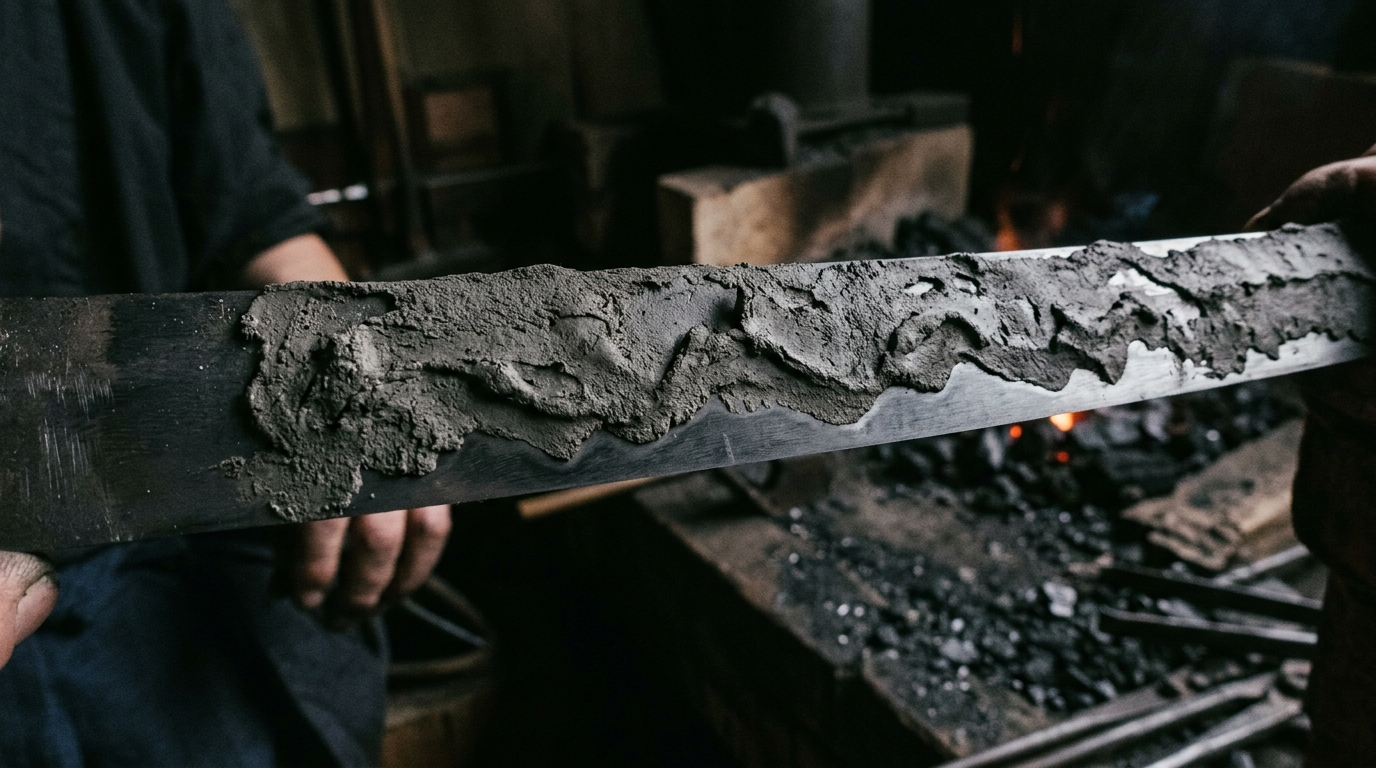
The most breathtaking phase of katana craft is Tsuchioki—the application of a specially prepared clay wash composed of clay, charcoal powder, and crushed river stone.
The smith paints a thick layer of insulating clay along the spine (Mune) and cheeks of the blade, while leaving only a millimeter-thin wash along the cutting edge. Across the boundary, the smith carves artistic transverse notches (Ashi).
5. Yaki-ire: The Thermodynamic Curvature Paradox
In a darkened smithy where the incandescent steel glow is judged strictly by eye (~1,470°F, color of the autumn moon), the blade is plunged tip-first into a trough of heated water.
The uninsulated edge cools instantly in fractions of a second, locking the austenite crystals into ultra-hard Martensite. Because martensite expands in crystalline volume, the blade momentarily bends sharply downward toward the edge. But as the thicker, clay-insulated spine cools seconds later into dense Pearlite, thermal contraction pulls the blade back, creating the elegant, spontaneous upward curve (Sori) that defines the Katana silhouette.
Where the hard martensite edge meets the softer pearlite spine, the famous milky cloud known as the Hamon is permanently etched into the steel. It is at once a physical testament to crystalline metallurgy and a masterpiece of Japanese spiritual craft.
Mastering the Anvil Rebound and Hammer Rhythm
The true secret to forging steel efficiently with minimal physical exhaustion lies in mastering the elastic rebound of a quality wrought iron or cast steel anvil. Striking with a relaxed wrist and allowing the natural 80% to 90% rebound velocity of the anvil face to return the hammer to the apex of the swing cycle reduces arm fatigue by more than half.
Every hammer blow should serve a distinct purpose—drawing, beveling, or planishing—with the blacksmith continuously rotating the workpiece between 90-degree orthogonal planes to maintain square geometry before radiusing edges into round or octagonal profiles.
Shop Safety, Eye Protection, and Fire Management
Operating a hot forge requires rigorous personal safety discipline. Always wear clear ballistic eye protection with side shields to guard against airborne slag and flying scale. Never wear synthetic fleece or polyester clothing that can melt onto skin upon contact with red-hot sparks; choose natural heavy cotton denim or leather shop aprons. Maintain an unobstructed 5-gallon water quench tub within arm's reach of the anvil horn for emergency tool cooling and fire suppression.